Abstract
Flow-based generative models have enabled remarkable progress in fast and controllable generation across continuous and discrete state spaces, yet existing parameterizations are constrained to fixed dimensions or fixed sequence lengths. Here, we introduce Expanding Generative Flows (EFlows), which define flows between distributions of increasing dimensionality along an expanding interpolant that grows the state by augmenting it with conditional noise.
Building on this construction, we propose Expanding Flow Maps (EFMs), a new class of flow maps that distill the expanding interpolant into efficient few-step generative models. Each EFM factors the map between any two timesteps into two learnable operations, an expand operator, which augments the state space with new coordinates or tokens conditioned on the current state, and a transport map, which pushes the expanded state forward along the interpolant. Composing these operators yields a single map that jointly expands and denoises the state, recovering existing fixed-canvas flows and flow maps as the special case in which the expand operator is the identity. We further extend the framework to the discrete simplex, enabling variable-size graph generation and variable-length sequence generation. Across both continuous and discrete modalities, we establish EFlows and EFMs as a principled framework for settings in which output size is itself a learned, controllable degree of freedom.
Key Contributions
- Expanding Generative Flows. We introduce Expanding Generative Flows (EFlows), a class of generative models defined on an expanding interpolant between distributions of increasing dimensionality. We formulate it as a piecewise-deterministic Markov process combining a transport term that describes smooth denoising with a jump kernel that describes jumping to higher dimensionalities.
- Expanding Flow Maps. We derive the Expanding Flow Map (EFM), which jumps between arbitrary points along the expanding interpolant by composing an expand operator, which augments a state with conditional noise, and a transport map, which pushes the augmented state forward over the time interval toward the target distribution.
- Discrete Expanding Flows and Maps. We extend expanding generative flows and flow maps to the discrete simplex, formulating expansion as insertions along a sequence or graph and unlocking few-step variable-length discrete generation in regimes where standard flow-based methods do not apply.
- Through experiments on molecular conformer generation, molecular graph generation, and language modeling, we establish EFlows and EFMs as a single, unified recipe for variable-dimensional generation across domains and at any sampling budget.
Overview of Framework
🌊 Expanding Generative Flows
The key limitation of standard flows is that the state space is fixed at initialization. We overcome this by defining generative flows between distributions of different dimensionality, specifically where the source has lower dimensionality than the target. We replace the fixed dimension $d$ with a non-decreasing schedule $d(t):[0,1]\to\mathbb{N}$, so the marginal $p_t\in\mathcal{P}(\mathbb{R}^{d(t)})$ lives on a state space whose dimensionality grows along the trajectory.
Because the source $\boldsymbol{x}_s\in\mathbb{R}^{d(s)}$ and target $\boldsymbol{x}_t\in\mathbb{R}^{d(t)}$ live in spaces of different dimension, no fixed-dimension velocity field can transport $p_s$ to $p_t$. We resolve this by augmenting the source with noise drawn from a tractable conditional distribution $p_{\epsilon|s,t}\in\mathcal{P}(\mathbb{R}^{d(t)-d(s)})$, lifting it to the target dimension before transport.
Because the state jumps to a higher dimension at each insertion, the two-stage expand-then-transport process is not a classical flow. We instead unify expansion and transport as a single piecewise-deterministic Markov process (PDMP) on the disjoint union of spaces $\mathcal{M} := \bigsqcup_t \mathbb{R}^{d(t)}$, whose generator combines a transport term for smooth denoising with a jump kernel for dimensionality increases.
🌊 Expand Operator
The expand operator $\mathcal{E}_{s,t}$ combines the existing coordinates of $\boldsymbol{x}_s$ with the latent coordinates of the augmented noise $\boldsymbol{\epsilon}$ according to a placement scheme.
It admits several instantiations depending on where new coordinates are placed.
- Concatenation. Append new coordinates to the end of the state, natural for autoregressive sequence generation or extending a point cloud.
- Positional Insertion. Interleave new entries at a subset of positions within the augmented state, suitable for any-length sequence generation or infilling.
- Child Expansion. Attach each new coordinate to a parent entry of $\boldsymbol{x}_s$ and initialize it relative to that parent, $\boldsymbol{x}_s^\epsilon[i] = \boldsymbol{x}_s[\mathrm{pa}(i)] + \sigma\boldsymbol{\epsilon}_i$, suitable for coarse-to-fine generation on structured states (e.g. resolving hydrogens around a heavy-atom backbone).
Since newly inserted dimensions are instantiated at different times, each component $i$ carries a local time coordinate $t_i = (t - t_i^{\text{ins}})/(1 - t_i^{\text{ins}}) \in [0,1]$, initialized at $t_i = 0$ at its insertion time $t_i^{\text{ins}}$.
🌊 Expanding Flow Map
The Expanding Flow Map (EFM) transports between two states along the expanding interpolant in a single learned step, jointly increasing dimensionality and pushing the flow forward in time. It is the composition of the expand operator and a fixed-dimensional flow map in the augmented space.
where $\Phi_{s,t}:\mathbb{R}^{d(s)}\to\mathbb{R}^{d(t)}$ and $v_{s,t}$ is the average velocity in the augmented state space. The EFM satisfies the same tangent and consistency (Lagrangian, Eulerian, semigroup) identities as fixed-dimensional flow maps, with the only difference being that velocities act on the expanded state $\mathcal{E}_{s,t}(\boldsymbol{x})\in\mathbb{R}^{d(t)}$. These translate into Lagrangian (LSD), Eulerian (ESD), and progressive/semigroup (PSD) self-distillation objectives that jointly train the expand operator $\hat{\mathcal{E}}_{s,t}$ and the velocity $\hat{v}_{s,t}$.
A notable property is that the EFM defines a stochastic flow map: the randomness from the conditional noise injection induces a distribution over trajectories, recovering the posterior $p_{t|s}(\cdot\mid\boldsymbol{x}_s) = (\Phi_{s,t}(\boldsymbol{x}_s))_{\#}\, p_{\epsilon|s,t}$ and enabling direct lookahead to all possible future states rather than a single deterministic trajectory.
🌊 Discrete Expanding Flow Maps
The framework is naturally positioned for any-length discrete generation, where a sequence or graph expands from a single token or node into a full sample. We define an expanding interpolant whose intermediate states grow in length via an insertion schedule $\alpha_t$, and learn a two-time insertion expectation $\hat{\mathcal{I}}_{s,t}(\boldsymbol{x}_s)[i]$, the expected number of tokens inserted into gap $i$ over $(s,t]$, trained with a Poisson-NLL insertion loss on both diagonal and off-diagonal time pairs. At inference, the discrete expand operator inserts $\ell_i$ latent tokens per gap, drawn from the exact conditional law of the interpolant, a Binomial over the remaining token budget.
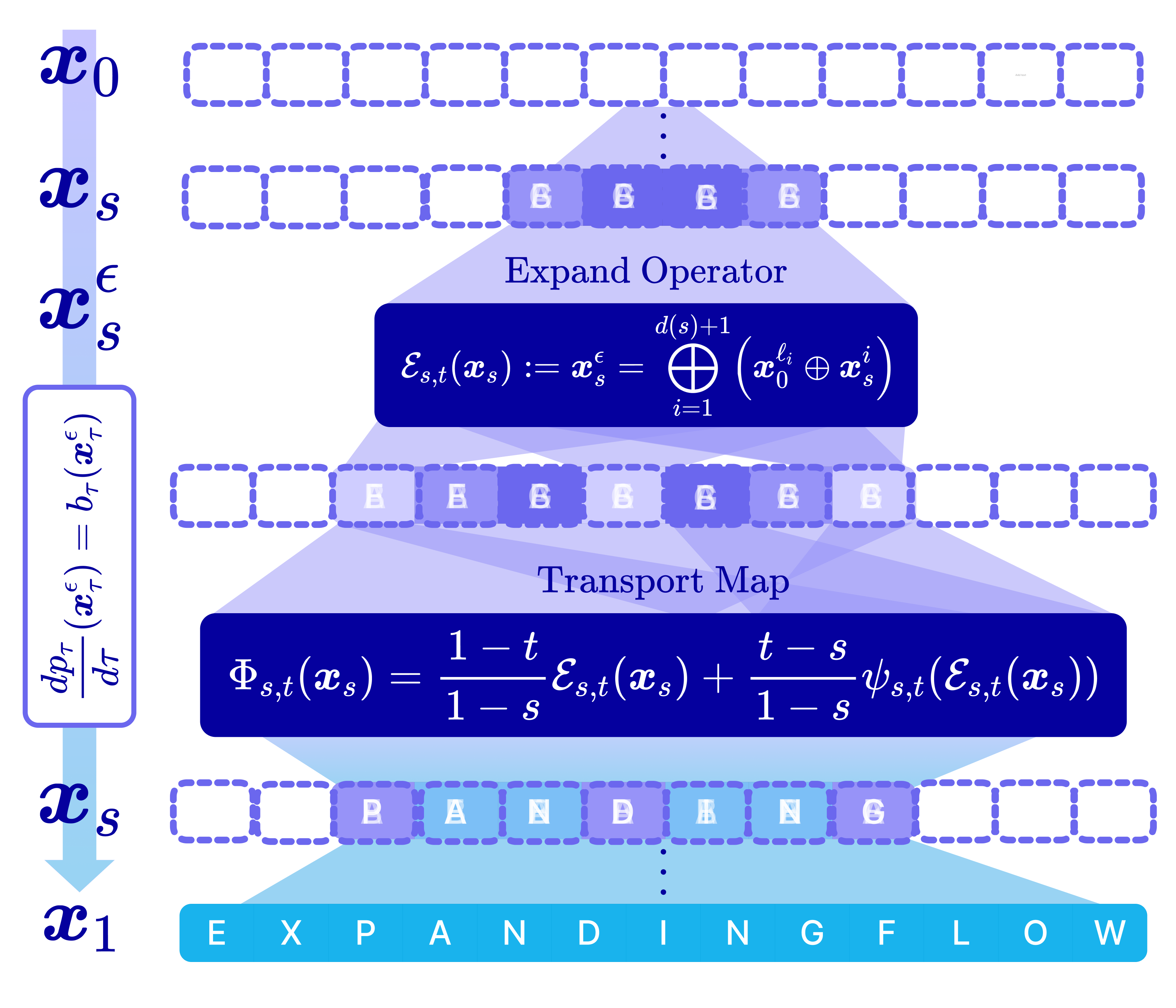
For many-step sampling the Binomial converges to the Poisson jump law of the PDMP, while for few-step sampling, where the operator must produce the whole sequence in one jump, the Binomial concentrates on the exact count with vanishing variance, avoiding the unbounded variance of the Poisson limit. Substituting the expanding mean denoiser into the flow map yields the discrete expanding flow map, which jointly inserts and denoises tokens toward the target one-hot distribution.
Since the mean denoiser $\hat{\psi}\in\Delta^{V-1}$, the discrete consistency identities are enforced via cross-entropy analogs of the Lagrangian, Eulerian, and semigroup objectives, jointly training $\hat{\mathcal{E}}$ and $\hat{\psi}$ for few-step variable-length generation.
Experiments
A single framework, EFlow and its distilled EFM, should extend across very different kinds of data whenever the output size is itself uncertain. The learned expand operator allows the dimension to grow dynamically along the trajectory, so neither the number of new coordinates nor where they are placed has to be fixed in advance. We test that generality on three deliberately dissimilar domains (continuous 3D molecular conformers, fully discrete molecular graphs, and variable-length text), each recast as the same expand-and-transport process over a canvas that grows as it generates.
Coarse-to-Fine Molecular Conformer Generation ⚛️
Our first domain is continuous 3D geometry: predicting molecular conformers on GEOM-QM9 and GEOM-Drugs. Here a conformer becomes a coarse-to-fine expanding interpolant. The heavy-atom backbone is denoised from Gaussian noise and frozen, then the hydrogens are inserted and resolved around it, the deterministic child-expansion case of the expand operator. An optional low-noise refiner sharpens local geometry, and distillation collapses the flow into a few-step EFM.
Table 1. Molecular conformer generation on GEOM-QM9 and GEOM-Drugs. Comparison against state-of-the-art multi-step diffusion models. Each cell reports Mean / Median. +R indicates sampling with 10 additional coordinate-refinement steps. Highlighted rows are ours. Bold is best, underline is second-best.
| Model | Steps | GEOM-QM9 ($\delta=0.5$ Å) | GEOM-Drugs ($\delta=1.25$ Å) | ||||||
|---|---|---|---|---|---|---|---|---|---|
| COV-R (↑) | AMR-R (↓) | COV-P (↑) | AMR-P (↓) | COV-R (↑) | AMR-R (↓) | COV-P (↑) | AMR-P (↓) | ||
| Multi-Step Diffusion | |||||||||
| GeoDiff | 500 | 87.80/93.66 | 0.318/0.322 | 46.25/45.02 | 0.617/0.511 | 64.12/75.56 | 1.144/1.130 | 43.16/42.02 | 1.381/1.331 |
| SubgDiff | 500 | 89.40/94.39 | 0.254/0.260 | 49.21/47.45 | 0.503/0.472 | 74.30/77.87 | 1.000/0.991 | –/– | –/– |
| MSGEN | 1000 | 88.36/95.10 | 0.261/0.233 | 49.54/48.39 | 0.493/0.462 | 85.06/97.16 | 0.954/0.948 | 49.28/48.20 | 1.314/1.272 |
| Multi-Step Expanding Flow | |||||||||
| EFlow | 20 | 88.51/93.01 | 0.385/0.359 | 53.07/52.27 | 0.519/0.489 | 81.78/90.91 | 0.997/0.983 | 55.88/61.58 | 1.267/1.203 |
| EFlow+R | 30 | 88.87/94.05 | 0.321/0.292 | 54.86/52.38 | 0.488/0.464 | 85.80/93.85 | 0.907/0.886 | 64.05/70.38 | 1.166/1.100 |
| Few-Step Expanding Flow Map | |||||||||
| EFM | 1 | 69.21/69.23 | 0.488/0.464 | 32.18/29.09 | 0.609/0.579 | 63.28/72.47 | 1.192/1.172 | 31.03/26.09 | 1.497/1.445 |
| EFM | 2 | 72.83/74.25 | 0.470/0.444 | 34.09/31.33 | 0.600/0.565 | 77.21/88.67 | 1.074/1.050 | 47.14/49.24 | 1.348/1.297 |
| EFM | 4 | 83.62/86.91 | 0.417/0.395 | 48.76/45.26 | 0.541/0.516 | 81.26/91.13 | 1.020/1.003 | 53.37/56.72 | 1.288/1.235 |
| EFM+R | 14 | 87.79/92.01 | 0.327/0.305 | 55.56/53.09 | 0.489/0.469 | 87.97/95.45 | 0.903/0.884 | 64.67/73.25 | 1.158/1.088 |
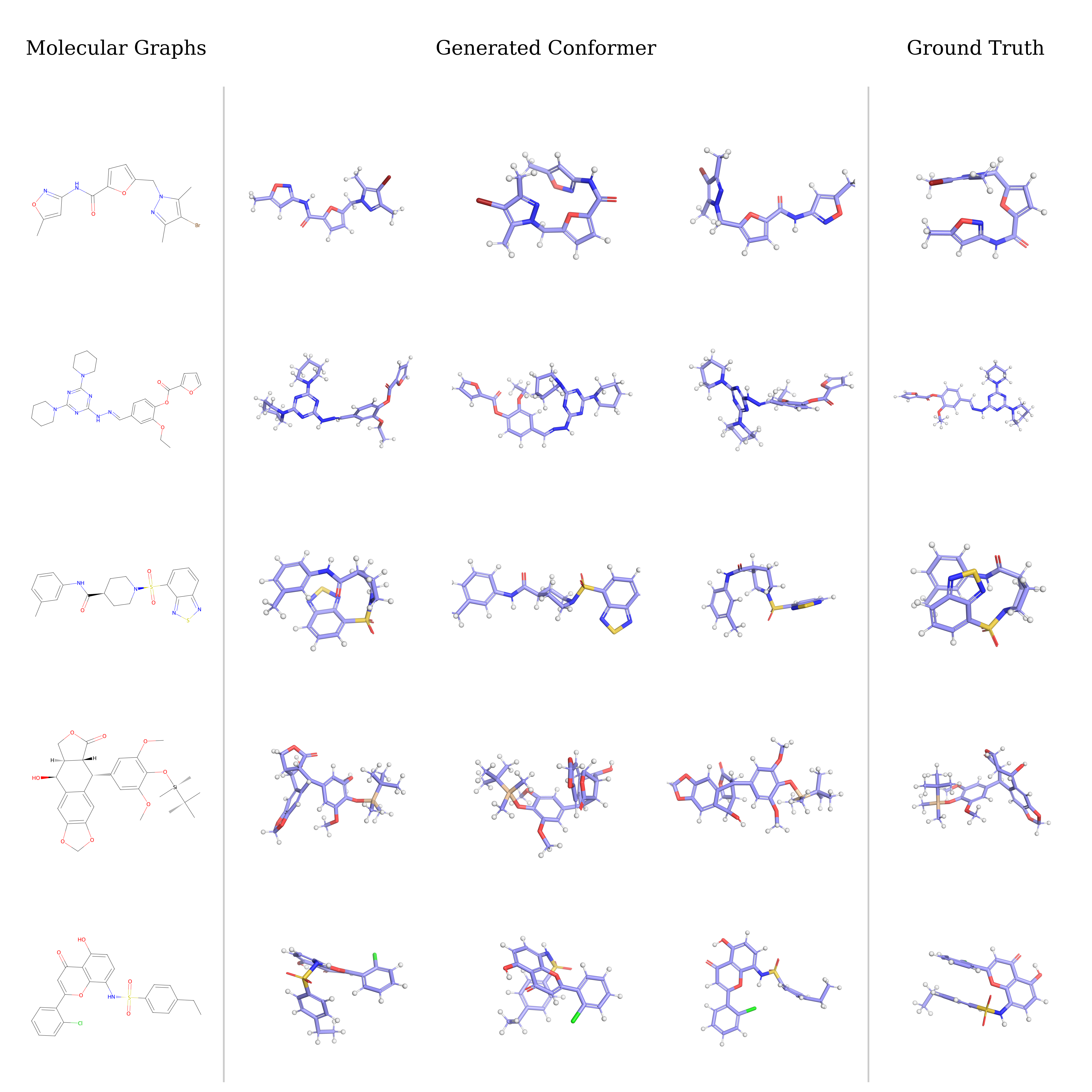
EFlow conformers on GEOM-Drugs.
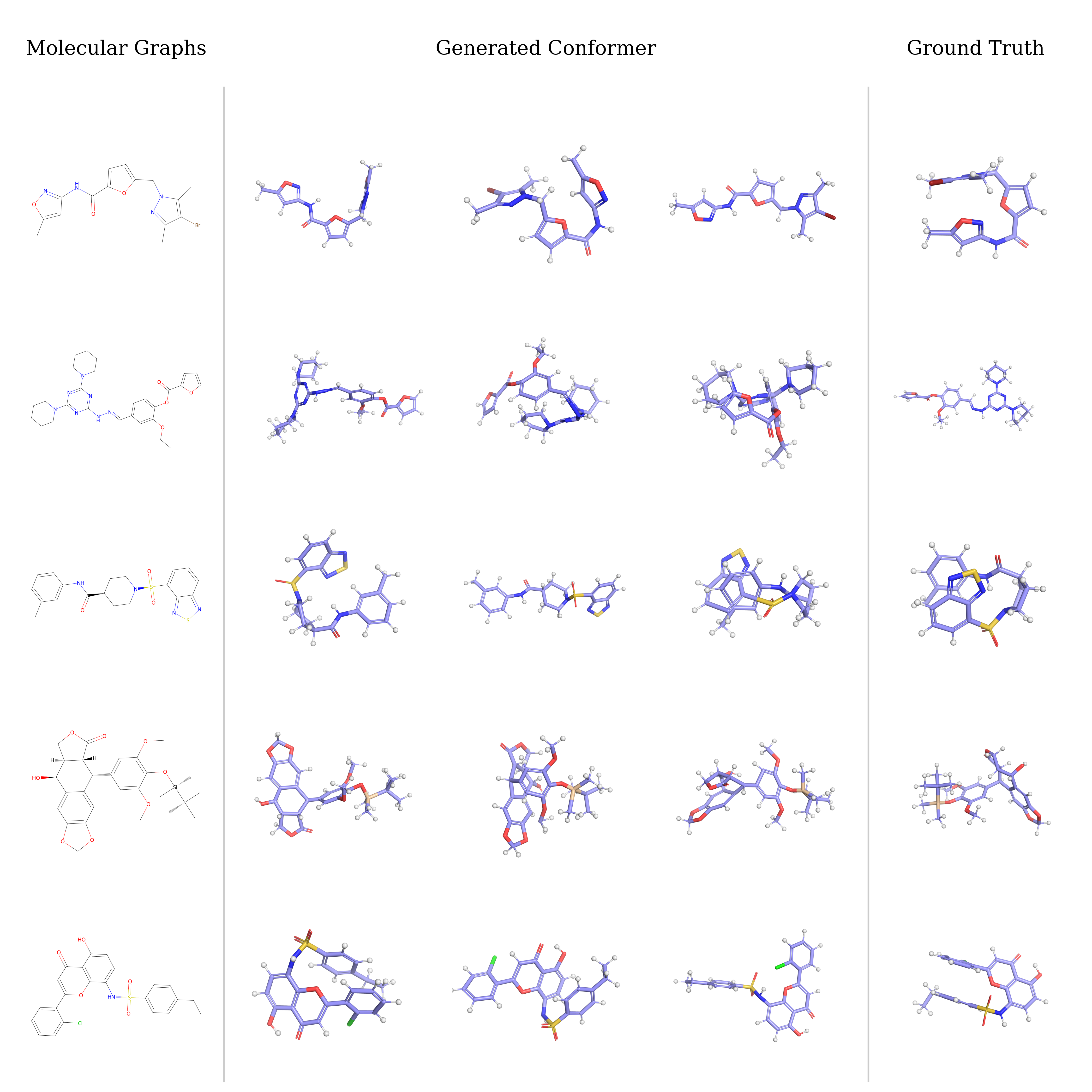
Few-step EFM conformers on GEOM-Drugs.
Discrete Molecular Graph Generation 🧬
Shifting from continuous coordinates to the space of discrete graphs, the same expand-and-transport framework generates drug-like molecular graphs on QM9. Now the interpolant grows over a variable number of nodes where each node carries its own insertion time, and a learned insertion head decides how many nodes fill each gap, expanding the molecule from empty to full size while node and edge categories denoise jointly, and EFM distills the process to just 1-2 steps.
Table 2. Discrete molecular graph generation on QM9. EFlow (ours) vs. the multi-step baseline DeFoG (top) and EFM (ours) vs. the flow-map baseline CFM (bottom), on 10,000 molecules. Highlighted columns are ours. Best FCD values are bold.
| Steps | Baseline | Ours (EFlow / EFM) | ||||
|---|---|---|---|---|---|---|
| Valid (↑) | Unique (↑) | FCD (↓) | Valid (↑) | Unique (↑) | FCD (↓) | |
| Multi-Step, DeFoG (baseline) vs. EFlow (ours) | ||||||
| 100 | 99.2 | 96.2 | 0.134 | 98.9 | 95.9 | 0.116 |
| 50 | 98.8 | 96.2 | 0.260 | 98.8 | 96.1 | 0.131 |
| 10 | 88.6 | 92.8 | 1.630 | 97.9 | 96.1 | 0.390 |
| 4 | 53.6 | 63.1 | 3.008 | 91.7 | 92.8 | 1.780 |
| Few-Step Flow Map, CFM (baseline) vs. EFM (ours) | ||||||
| 2 | 91.1 | 97.6 | 0.49 | 90.0 | 97.9 | 0.40 |
| 1 | 90.0 | 91.8 | 2.14 | 90.2 | 97.7 | 0.44 |
Insertion-Based Language Modeling ⚡
Finally, the framework carries over to variable-length sequences with unconditional text generation on the One Billion Word benchmark (LM1B), scored by generative perplexity (Gen. PPL) under GPT-2-Large and by the entropy of the generated tokens. Because generation proceeds by insertion, the flow does more than pick a sequence length. Conditioned on its current trajectory, it also learns which tokens to insert and where they belong between the tokens already placed. Where other models pad to a fixed length or lean on end-of-sequence tokens, this same expanding mechanism composes these trajectory-conditioned insertions with denoising transport to emit text of native, variable length, and its few-step EFM writes whole sequences in just a few steps.
Table 3. Multi-step EFlow on LM1B. Gen. PPL (↓) and entropy across budgets vs. the fixed-length flow language model FLM. Highlighted columns are ours. Best Gen. PPL is bold.
| Steps | EFlow (ours) | FLM | ||
|---|---|---|---|---|
| PPL (↓) | Ent. | PPL (↓) | Ent. | |
| 1024 | 103.63 | 4.16 | 111.36 | 4.30 |
| 512 | 110.97 | 4.16 | 114.89 | 4.31 |
| 256 | 117.69 | 4.16 | 120.19 | 4.32 |
| 128 | 126.20 | 4.15 | 129.06 | 4.34 |
| 64 | 133.62 | 4.14 | 143.73 | 4.36 |
Table 4. Few-step EFM on LM1B. Gen. PPL (↓) and entropy at 1, 2, and 4 steps vs. distilled diffusion and flow-map baselines. Highlighted row is ours. Bold is best, underline is second-best.
| Method | 1 step | 2 steps | 4 steps | |||
|---|---|---|---|---|---|---|
| PPL (↓) | Ent. | PPL (↓) | Ent. | PPL (↓) | Ent. | |
| Duo + DCD | 1224.52 | 4.33 | 520.08 | 4.20 | 210.88 | 4.23 |
| Duo + Di4C | 292.94 | 3.79 | 247.69 | 3.87 | 150.67 | 4.00 |
| MDLM + SDTT | 1429.48 | 4.31 | 602.14 | 4.28 | 241.01 | 4.28 |
| MDLM + Di4C | 1217.10 | 4.38 | 621.59 | 4.37 | 247.32 | 4.00 |
| CFM | 269.72 | 3.10 | 267.39 | 3.15 | 267.97 | 3.28 |
| FMLM | 119.34 | 4.16 | 110.19 | 4.21 | 98.76 | 4.21 |
| EFM (ours) | 98.35 | 3.56 | 125.95 | 3.95 | 99.85 | 3.93 |
EFlow (multi-step)
[CLS] the side. [SEP] i'm guessing that it is are based on a and point. [SEP] he called the old life,'bo the, of andal'to mr. [SEP] and his father. [SEP] the hon in given patients to an does not or a test. [SEP] i was not to for her. [SEP] by way, it is not to be a, but available to be funny as well - - just as a party. [SEP] i am waiting for it to happen for each firm. [SEP] craig ward made 30 saves for the defending st louisny and antoine vermo on its 13out, including six - [SEP]
[CLS] is scheduled to be monday. [SEP] they are appealing against two key yesterday. [SEP] i'm never sure how much i mean. [SEP] he said, " a friend has come a little down and has been making the most into again. " [SEP] by the time, last week, some 5, 000 tamil there were living in the, which on have year, an even the s at found. [SEP] the price of gasoline was 2. 7 % compared with the previous year. [SEP] the next morning mr cameron said that he would not be able to give london to for the expense of defence. [SEP] they study the verys so that [SEP]
[CLS] spent 15 years in prison at a $ 1 million military camp in afghanistan. [SEP] there's a face on it, we can't look like our else. [SEP] he never lost the great of the before. [SEP] court's bemourned her on tuesday. [SEP] two teenagers have died from a serious wound in hospital. [SEP] the military alone was not enough to force the points. [SEP] adjusted for inflation, m. a. n. m. was up 4. 2 percent, but is up slightly. [SEP] " it is a job we have agreed for as well as with the new - community policing group. [SEP] [SEP]
[CLS] - hitter, will win against the wall. [SEP] no wonder it was right? [SEP] the wall street agency said the biggest threat to the financial system is from individuals and the, caused of over $ 3 million in assets. [SEP] the public library at the university is having a lowdown on film. [SEP] japan's olympic committee will meet again on monday. [SEP] it is a difficult ( and sometimes expensive ) decision to make with us, but it also takes time and effort to do with the usual for ofs. [SEP] of the world's three countries with low - on economies face up to 22pc of gdp, most has [SEP]
Few-step EFM
[CLS] the into being us. [CLS] it [CLS] for a the state. [CLS] more than a state. [CLS] after, we are. [CLS] the first time off the president and the who would - at least [CLS] : and after days - percent of, when would be their an, of, go to to off about in two about to to a about more than their second into [CLS]t they to more, when it to an into the deal. [CLS] from was the, [CLS].'over the are of you two. on make two being., who now have to to another,, one of the of its with from if alls [CLS]
[CLS] country. [CLS] but well it will not see after all in the high school of, tenn. [CLS] the most important of his first second in three years which has left over more on u. s. house. [CLS] it's do, and that's a good country in city high points. [CLS] well, one week, as well as he's trying to be up by half two points. [CLS] the 23 - year - old's house, they are more important is the country's own win, and when they are once in the game house because he is to work for the most next, but an [CLS]
[CLS] second just to [CLS] his own city, while it's on to three - world countries such as the united states, too left for this year. [CLS] more than i do later has to me been asp. [CLS] i don't want three call he 24 to be [CLS], " she said. [CLS] he then can at least her once again again for two days. [CLS] but. i go at the university. [CLS] she was not [CLS] next week or there's already ever later [CLS]. [CLS], [CLS] 6 ( upi ) - - - they are another lead to the - john in an a through last - like [CLS]
[CLS] every year. [CLS] he was one after his week's only, has been on top of the world. [CLS] he had his team on the close, at least in this week. [CLS] " i have people, who do not think it's close to keep up to be it in party, " the said. [CLS] a last week's. man of years last week, first four of the children - were made on tuesday with me. [CLS] that's not all. [CLS] but there have been four al - qaeda, which don't the right four two go to the country. they million ifs of these [CLS]
BibTeX
@article{tang2026expanding,
  title={Expanding Flow Maps},
  author={Sophia Tang and Pranam Chatterjee},
  journal={arXiv preprint arXiv:2607.21585},
  year={2026}
}